The Weight of Judgment
Few punishments in medieval legal history evoke such dread as peine forte et dure — a method in which silence itself became a crime, and pressure became the instrument of justice. This brutal practice was used when an accused refused to plead during trial. Without a confession or denial, the court could not proceed, and so the body became the battlefield on which law forced a verdict.
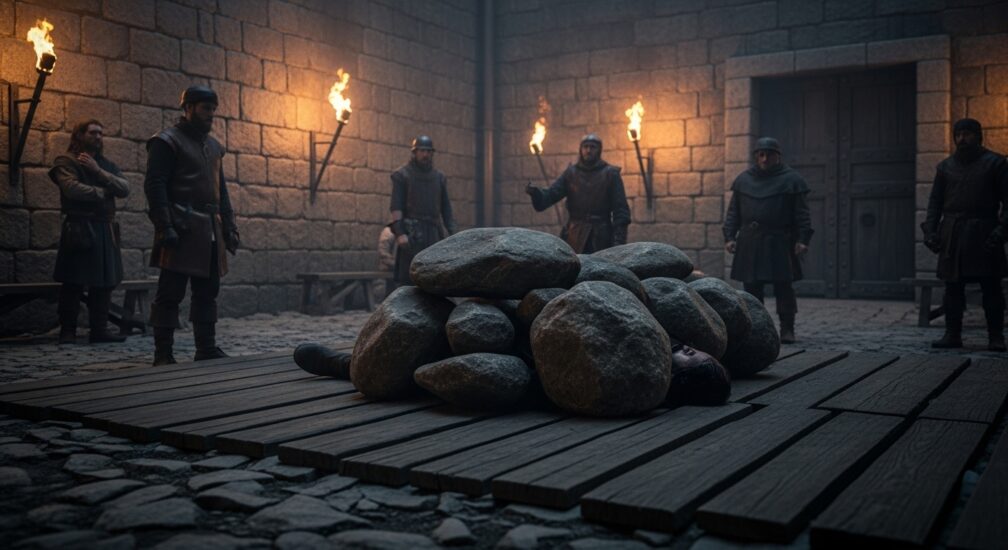
Under this system, death by pressing was not the immediate goal. Instead, authorities aimed to break resistance through unbearable weight, compelling the accused to speak. But many chose defiance, enduring a punishment where stones were added one by one until the chest collapsed. The stillness that followed was both a final refusal and a final victory — the ultimate form of rebellion carved into silence.
The Ordeal of Slow Crushing
To experience pressing to death was to enter an ordeal designed to erase breath, movement, and hope. Victims were placed on the ground with boards or iron slabs laid over the body. Then came the stones — heavy, cold, and deliberate. They represented not only pressure, but the authority of the court, manifesting judgment through weight alone.
As the load increased, the body strained under the rising mass. Ribs buckled, lungs compressed, and suffocation tightened its grip long before the final moment. This slow crushing punishment was both mechanical and symbolic: the law literally pressing obedience out of the uncooperative.
Executioners, tasked with overseeing this grim ritual, acted almost ceremonially. Some added stones rhythmically, others paused to demand a plea. And yet many victims kept their silence, turning suffering into an act of defiance that history still remembers.
Pressing Punishment and the Power of Silence
In England and parts of Western Europe, pressing punishment served as a tool not only of justice, but of control. Courts feared the loophole created by a silent defendant. Without a plea, property could not be confiscated, and guilt could not be formally declared. Thus, pressing execution became a weapon of legal order — a means to force cooperation or destroy resistance.
The punishment blurred the line between confession and coercion. Each stone symbolized the struggle between authority and human will, between law and the desperate instinct for survival. Those who died under the crushing weight were often regarded as martyrs of stubbornness, their torment a testament to the cost of defiance.
Even in its cruelty, pressing torture exposed fundamental concerns about medieval justice: how far could the state go to impose order? When did punishment become oppression? And could silence ever be considered guilt?
A Chamber of Authority and Fear
Historical records describe dim chambers and secluded yards where the boards were placed and the stones brought forth. The scene was grim but methodical. Each act of crushing reinforced the verdict the court demanded — even if no words were spoken.
In this space, agony became language. The body, pinned and immobilized, expressed resistance stronger than any spoken plea. But as pressure built, endurance waned. Authorities saw the collapsing chest as a final acknowledgment of the state’s power, a warning to others who might challenge judicial procedure.
Yet for the condemned, the moment of final collapse was often described as a kind of release — the end of repression and the beginning of eternal silence.
Remembering the Ritual of Crushing
Today, the legacy of peine forte et dure survives through historical records and museum reconstructions. At the Medieval Torture Museum in Chicago, visitors encounter exhibits that show the physical reality of medieval crushing devices and the chilling logic behind them.
The Medieval Torture Museum in Los Angeles expands on this narrative, exploring how silence, coercion, and the need for a plea shaped some of the darkest legal punishments in history.
Meanwhile, the Medieval Torture Museum in St Augustine preserves gripping displays that reveal the ritualistic nature of slow crushing — a method where weight carried both literal and symbolic force.
For readers seeking deeper reflection on punishment, repression, and the psychology of fear, the museum’s blog offers essays on how medieval justice balanced authority with cruelty.
The Silence That Outlived the Stones
The story of peine forte et dure is not merely one of brutality, but of the strange power of silence in the face of overwhelming force. The punishment embodied the clash between individual will and institutional demand, between the right to resist and the state’s desire for order.
By examining this form of crushing execution, we confront a haunting truth: justice, when stripped of compassion, can become indistinguishable from terror. The stones that once crushed bodies now weigh on our understanding of medieval law — reminding us how fragile the boundary is between judgment and cruelty.