Quick note before we start. If you landed here looking for fireworks, or the band, this isn’t that page. What follows is about an actual execution method used in medieval Europe, and it’s grim even by the standards of that era. Courts relied on it for centuries. The person tied to it didn’t always die fast. Some lasted hours. A few, going by surviving accounts, lasted longer than that.
Quick answer
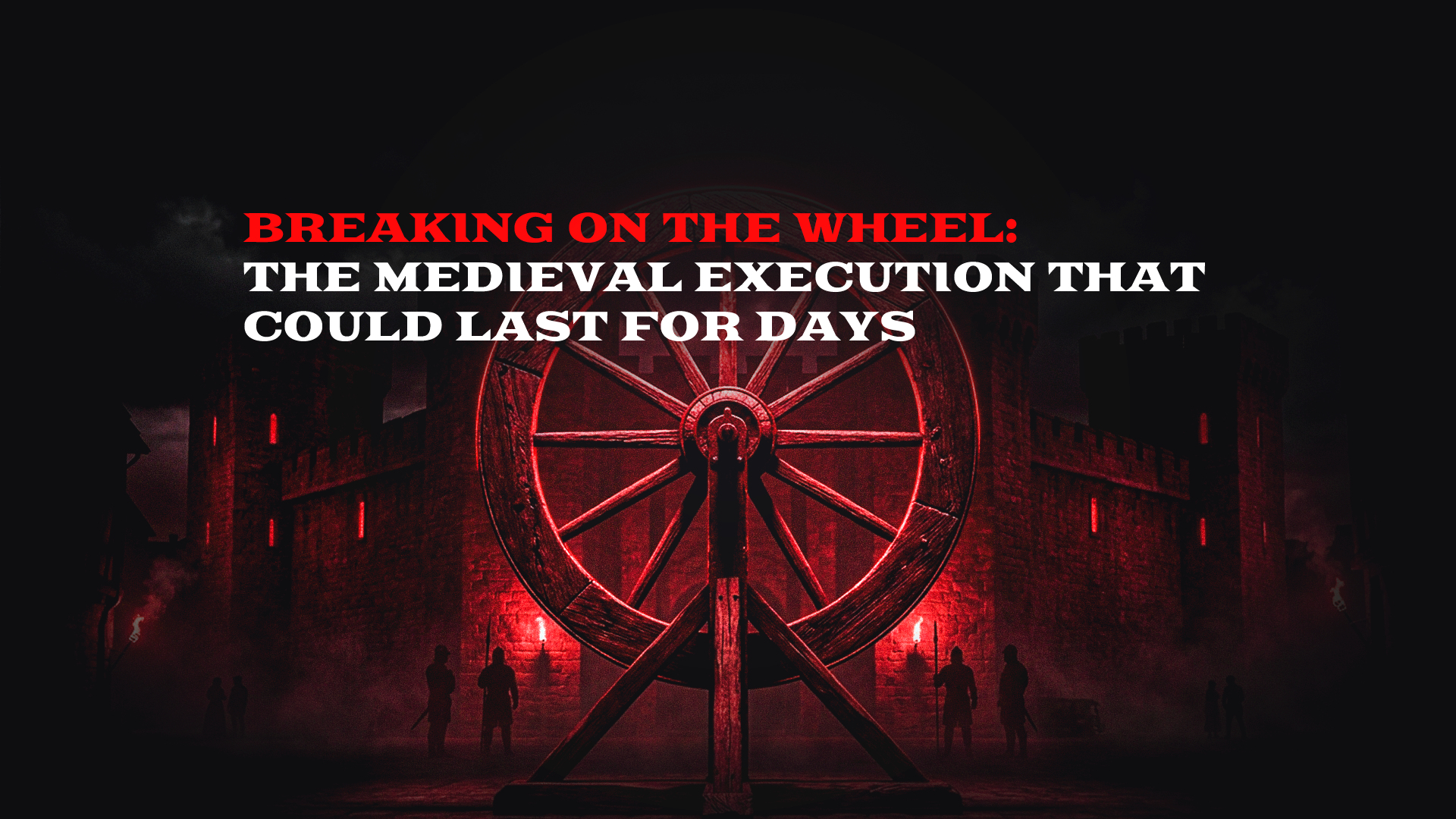
The breaking wheel was a medieval execution method that used a large wagon wheel, or a similar wooden frame, to break a condemned person’s bones one at a time with a heavy iron bar. German and French courts used it mainly for murder, armed robbery, and other serious violent crimes. Sometimes death came fast, through a mercy strike to the chest or neck. Other times, when the court ordered the slower version, it dragged on for hours.
What Breaking on the Wheel Was
At its core, breaking on the wheel meant tying a condemned person to a large wheel, similar to a cart wheel, and striking each limb with a heavy iron bar until the bones gave way at the joints. Once every limb had been broken, executioners often left the body on the wheel, hoisted onto a pole so the crowd below could see it.
Courts didn’t hand out this sentence lightly. It was reserved for crimes they considered especially severe: murder first and foremost, but also armed robbery and, in some regions, arson that resulted in a death. Inside the Holy Roman Empire it worked as what’s sometimes called a “mirror punishment.” The idea was that the method of execution should echo the crime itself. A highwayman who’d beaten travelers might face the same treatment in a public, ritualized form.
None of this was improvised. Legal texts from the period, the German Sachsenspiegel among them, laid out exactly which crimes called for it and how a sentence should proceed. That kind of legal specificity says a lot. This wasn’t a mob deciding on the spot. It was a formal procedure, written into law, carried out by executioners who did the job as a trade rather than a one-off act of anger.
Breaking a limb cleanly at the joint took real skill, oddly enough. A sloppy strike could leave someone in worse pain without moving the sentence forward at all. Towns kept dedicated executioners for this reason, men who trained for years and often inherited the role from a father or uncle before them. There’s something strange about how professional the whole system was, given how brutal the actual punishment could get.
Location mattered too. Executions typically happened just outside town walls, at a site reused again and again, sometimes marked by a permanent platform. Crowds showed up because the punishment was meant to be seen. A sentence nobody witnessed did nothing to warn anyone off future crime, so word spread on purpose, and people came.
Age and sex sometimes changed how the sentence was carried out, though rarely whether it was handed down at all. Some regional courts spared younger offenders the prolonged version, opting for a quicker death by mercy strike even when the crime itself would have called for the harsher form. Women convicted of capital crimes were, in some jurisdictions, executed by other methods entirely, since breaking on the wheel was widely treated as a punishment aimed specifically at men. None of this made the underlying system gentler. It just shows how many small decisions went into a single sentence.
How It Worked
The “Coup de Grâce” vs. the Prolonged Version
Whether someone died fast or slow on the wheel came down to one decision the court made in advance. A mercy strike, or coup de grâce, ended things quickly. The executioner delivered one or two blows straight to the chest or throat, sometimes before the limbs were even fully broken, and death followed within minutes.
Skip that mercy strike and everything changes. Every limb got broken in order, and the executioner avoided the torso and head on purpose, keeping the condemned alive and aware through the whole ordeal. Once the limbs were done, the body was woven through the spokes and raised into the air, left to die slowly from shock, blood loss, or exposure. This could stretch out over a full day, sometimes more.
Judges picked between these two options based on how serious they judged the crime, and occasionally on how much public anger a case had stirred up. Someone who’d killed a noble or a member of the clergy stood a much better chance of facing the prolonged version than a person convicted of a lesser violent offense. That choice itself was a message, sent before the execution even began, telling everyone watching exactly where the line sat.
The sequence of strikes wasn’t left to chance either. Executioners generally worked from the outside in, starting with arms and legs and only moving toward larger bones afterward, rather than hitting wherever happened to be convenient. Some regional laws even specified the number of blows a given sentence required, which turned the whole thing into something closer to ritual than a simple beating. That structure is part of what made the punishment so feared. It wasn’t chaos. It was control, applied to a human body over as long a stretch as the court decided.
Actual survivors were rare, and when they did happen, it usually came down to a crowd stepping in or a pardon arriving at the last minute rather than anything about the method itself being survivable. A handful of historical accounts describe prisoners lingering on the wheel for a full day or more, with onlookers drifting in and out as the hours passed. It’s hard to say how exact those accounts are after centuries of retelling, but they line up with what we know about how the prolonged version was designed to function.
One case that shows up repeatedly in the historical record involves an assassin condemned for killing a bishop in Prussia. Court documents describe him being strangled before the wheel could finish its work, a small mercy squeezed in even under a sentence built to avoid one. Cases like that suggest the system wasn’t uniformly rigid in practice, even when the law on paper called for a specific, unforgiving sequence of events.
St. Catherine and the Catherine Wheel
The breaking wheel picked up the nickname “Catherine wheel” thanks to a legend tied to St. Catherine of Alexandria, a Christian noblewoman said to have lived in Roman Egypt in the early fourth century. According to the story, she refused to give up her faith and was sentenced to die on a spiked wheel built specifically to torture her.
As the story goes, the wheel shattered the instant Catherine touched it. Furious at what looked like divine intervention, the authorities had her beheaded instead. Historians still debate whether Catherine actually existed. Her cult grew massively across medieval Europe and the wheel became her defining symbol in art and iconography.
That symbolism turns up unexpectedly today. The spinning firework everyone calls a “Catherine wheel” borrows its name directly from this legend, and so does the Catherine wheel window design found in Gothic cathedrals. Even a species of jellyfish carries the name.
Catherine became one of the most widely venerated saints of the medieval period. Her feast day, November 25th, was observed across much of Christian Europe for centuries. Guilds of wheelwrights and millers, whose work revolved literally around wheels, took her on as a patron saint. That’s only tightened the link between the symbol and the story in people’s minds.
It’s worth being clear that the legend and the historical execution method aren’t quite the same object. The wheel described in Catherine’s legend was built specifically to torture her, spiked and mechanized in a way that reads more like religious storytelling than documented medieval engineering. The breaking wheel used in real German and French courts centuries later was a much plainer device, closer to an ordinary cart wheel than anything the legend describes. The name outlived the specific details.
Where and When It Was Used
Breaking on the wheel first was mentioned in antiquity, but it became a fixture of criminal law in medieval and early modern Europe, particularly in German-speaking territories and France. Then German courts used it well into the 1800s, applying it under regional law for murder and other capital crimes long after much of Western Europe had already moved away from public torture-executions.
France used the method too, they formalized it under the name supplice de la roue. It remained part of French criminal punishment for centuries and only falled out of use around the time of the Revolution. Under King Francis I in the sixteenth century, breaking on the wheel became the standard sentence for highway robbery specifically. This crime French authorities treated with unusual severity because of how much trade and travel depended on safe roads. Records describe sentences handed down well into the 1700s, right up until the wave of penal reform following the Revolution swept the old system away.
German-speaking territories had no single unified law. The Holy Roman Empire was a patchwork of regions, and each one ran its own criminal code.That’s a big part of why abolition happened so unevenly across German lands. Some regions was still holding onto the punishment.
The practice ended gradually rather than all at once. Bavaria abolished it in 1813. The Electorate of Hesse followed in 1836. The last confirmed execution by the wheel took place in Prussia on August 13, 1841. By then, Enlightenment-era ideas about proportionate punishment had already pushed most of Europe toward less theatrical forms of execution, and the wheel simply held on as one of the last holdouts before it finally went too.
Legal reformers of the period, figures like Cesare Beccaria in Italy, argued openly that punishments this severe did little to actually deter crime and mostly just brutalized the societies that carried them out. Those arguments spread across Europe through the eighteenth century, slowly eroding the political will to keep sentences like this on the books. By the time Prussia carried out its final execution by wheel in 1841, the method already felt like a relic even to the people watching it happen, a leftover from a legal tradition most of the continent had already started to leave behind.
See the Wheel for Yourself
Reading about the mechanics of a breaking wheel is one thing. Standing in front of an actual reconstruction gives you a much clearer sense of how it worked and why it terrified people for so long. At the Medieval Torture Museum, you can see devices connected to this exact execution method, each displayed with the historical context behind how courts actually used them.
If this kind of history interests you, go see it in person if you get the chance. Photos flatten the scale of something built specifically to break a person joint by joint in front of a crowd. You can plan a visit and check current exhibits at the Medieval Torture Museum.