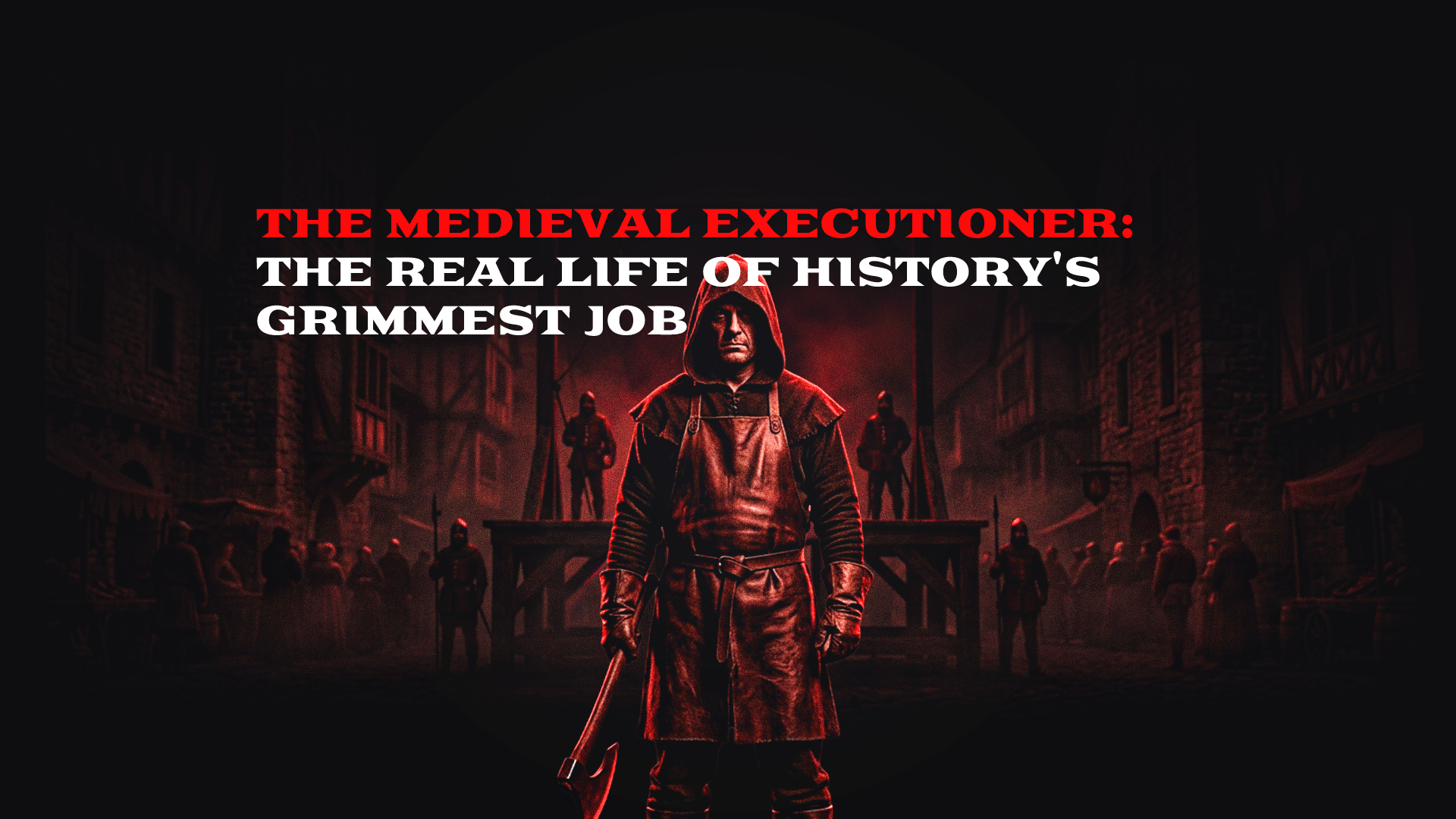
Most people picture a hooded giant swinging an axe and nothing else. The real medieval executioner looked almost nothing like that. He usually lived on the edge of town, married into a small handful of families willing to have him, and spent far more of his working life scraping dead animals off the street than beheading anyone. Being a medieval executioner meant carrying a job nobody else wanted, one that paid steadily but cost you your place in polite society the moment you took it. Here’s what that life actually looked like, fact by fact.
How The Medieval Executioner Real Life Looked Like
A medieval executioner was a town-appointed official who carried out death sentences, torture, and interrogations, but also handled a wide range of “unclean” jobs like removing carcasses, cleaning latrines, and slaughtering diseased livestock. The role often ran in families for generations, since almost nobody else would marry into it or take it up voluntarily. Executioners were paid a fixed salary plus fees per task, and despite their reputation, most didn’t wear the black hood popular culture loves to give them.
Who Became an Executioner
Most medieval executioners inherited the job. Sons learned the trade from their fathers the same way a blacksmith’s son learned to work iron, picking up the skills of hanging, beheading, and interrogation as a family craft passed down across generations. This wasn’t a coincidence. Once a family took on the role, few other paths stayed open to them.
Towns treated the executioner’s position as a dishonorable trade, which meant almost nobody chose it freely. Men ended up in the role because their father held it before them, because they’d fallen into debt with no other way out, or because they’d already been branded a criminal and this was one of the only paying jobs left available to them. A convicted thief sometimes traded his own execution for a lifetime spent carrying out other people’s.
Once someone took the job, leaving it again was nearly impossible. The stigma attached to an executioner’s name followed his children and grandchildren, whether or not they ever picked up a sword themselves. That’s a big part of why the same surnames show up again and again in town records across a century or more, families like the Schmidts in Germany or the Sansons in France, locked into a trade nobody else would touch.
Some men entered the trade through even more unusual routes. A handful of towns recruited former soldiers who’d already grown used to violence, figuring military experience translated reasonably well into the physical demands of the job. Others came from families of gravediggers or knackers, trades already carrying their own social stain, so the shift into execution work didn’t cost them much additional standing they hadn’t already lost. Whatever the path in, almost nobody arrived at the job by simple ambition.
Training took years, not weeks. A young apprentice learned to swing a sword cleanly enough to sever a neck in one stroke, since a botched beheading humiliated the executioner publicly and could provoke a furious crowd. He also had to learn the mechanics of hanging, the specific procedures for various forms of torture the court might order, and enough basic anatomy to keep a victim alive through an interrogation the law required to stop short of death. None of this got written down in any formal curriculum. It passed from father to son, or master to apprentice, through direct demonstration.
The Job Itself
An executioner’s real workload went far beyond carrying out death sentences. He handled hangings, beheadings, and floggings, yes, but towns also called on him for torture sessions ordered by the court, and for the kind of filthy labor no honest tradesman would agree to do. Removing animal carcasses from the streets, cleaning out latrines, and disposing of diseased or contagious livestock all fell under his job description too.
This second category of work mattered just as much as the executions, in terms of how the job actually paid. Towns needed someone to deal with dead horses, plague victims, and infected animal carcasses on a regular basis, and the executioner was often the only person contractually obligated to do it. In many towns, this side work brought in steadier income than executions themselves, since a town might go months between hangings but needed carcasses cleared every week.
Executioners often picked up practical medical knowledge along the way, and some built real reputations as healers on the side. Frantz Schmidt, the Nuremberg executioner whose diary survives today, treated patients with herbal remedies and basic surgery for decades, using the same anatomical knowledge his job forced him to develop. That crossover between killing and healing sounds strange now, but it made a certain grim sense at the time. Nobody understood the human body’s limits better than the man paid to break it.
The tools themselves demanded upkeep and expertise too. A sword used for beheading had to stay sharp enough for a single clean stroke, and executioners often owned and maintained their own blade rather than relying on whatever the town happened to keep in storage. Some swords survive today engraved with mottos or dates, treated less like disposable equipment and more like the mark of a serious professional trade, passed down alongside the job itself.
Not every town could justify a full-time executioner on salary alone, especially smaller settlements without a steady stream of capital cases. Some towns instead shared an executioner with neighboring communities, calling him in for scheduled executions and paying per job rather than keeping him on permanent staff. This arrangement stretched a single executioner’s reputation, and his travel time, across a wider region than his home town alone.
Social Stigma
Executioners lived apart from the rest of the town, often literally, in a house set outside the main walls or tucked into a specific street nobody else wanted to occupy. Their profession fell into a category German records called “unehrlich,” meaning dishonorable, a legal and social status that stripped away rights other tradesmen took for granted. An executioner couldn’t join a craft guild, testify in most court cases, or hold public office, no matter how skilled or wealthy he became.
Marriage options narrowed just as sharply. Executioners’ families mostly married within a small circle of other “unclean” trades: gravediggers, skinners, knackers, and other people whose work involved corpses or waste in one form or another. This wasn’t tradition for its own sake. It was practically the only marriage market left open to them, since respectable families refused to let their children marry into a household carrying the executioner’s stigma.
Children inherited the stain without ever touching a rope or an axe. A boy born to an executioner faced the same guild bans and social exclusion his father did, purely by birth. That’s the real engine behind these hereditary executioner dynasties. It wasn’t always a passion for the trade being passed down. It was a closed door everywhere else, generation after generation.
Even everyday interactions carried this stigma along with them. In some towns, other residents avoided shaking an executioner’s hand or sharing a drink at the same table, treating physical contact with him as something that could rub off, almost like a contagion. Churches sometimes seated executioners’ families in separate pews, or denied them burial in the main churchyard entirely, pushing the stigma past death itself. A family could hold the job for generations and still never fully shed the sense that they existed just outside the community they served.
A few executioners tried, and occasionally managed, to buy their way out of this status. Petitioning a local ruler or the emperor for a formal restoration of honor was possible, though rare and expensive. Success meant a family’s name could finally join a guild or marry freely outside the small circle of other unclean trades, but it required money, influence, and often decades of built-up reputation most executioners never accumulated.
The Famous Ones
A handful of executioners left records detailed enough that we know them almost as individuals rather than just job titles. Frantz Schmidt worked as executioner for Bamberg and then Nuremberg from 1573 to 1617, carrying out more than 350 executions over his career while keeping a private diary the entire time. He’d learned the trade under his own father and started performing executions himself at eighteen.
Schmidt’s diary reads less like a confession and more like a ledger, listing names, crimes, and methods with almost no editorializing. What makes it remarkable is what happened afterward. Schmidt spent decades practicing medicine on the side, built a genuinely respected reputation among Nuremberg’s citizens, and eventually petitioned the Holy Roman Emperor to have his family’s hereditary dishonor lifted. He succeeded, late in life, becoming one of the rare executioners to shed the stigma his job carried.
France’s Sanson family ran an even longer dynasty, holding the position of royal executioner across six generations from the 1600s into the 1800s. Charles-Henri Sanson, the most famous member of the family, served during the French Revolution and personally carried out the execution of King Louis XVI. The Sansons kept meticulous records of their own too, and their long, unbroken tenure shows just how entrenched these executioner families could become within a single legal system.
Both families illustrate something worth sitting with: the job created its own strange kind of institutional memory. A Schmidt or a Sanson wasn’t just repeating a set of physical skills passed down at home. He was inheriting decades, sometimes centuries, of accumulated procedure, legal precedent, and personal reputation attached to a single surname. That inheritance cut both ways. It gave these families an unusual depth of professional expertise, and it also meant the stigma never had a chance to fade before the next generation picked the job back up.
The Myth of the Black Hood
The image of a masked executioner in a black hood is mostly Hollywood, not history. Across most of medieval and early modern Europe, executioners worked with their faces uncovered, in full view of the crowd that gathered to watch. Anonymity wasn’t the goal. Towns wanted their executioner recognized, accountable, and clearly tied to the office he held.
Some regions did require executioners to wear distinctive clothing, but it usually served the opposite purpose of a disguise. Certain German towns mandated specific colors or markings that made the executioner instantly identifiable in public, a badge rather than a mask. The point was making sure everyone knew exactly who this person was and what role he served, not hiding his identity from the crowd.
Masks and hoods do show up here and there in the historical record, just not as the standard uniform popular imagination assumes. A handful of isolated cases and later illustrations depict covered faces, and those images likely fed the myth that grew around the profession over the following centuries. But for most working executioners, the job came with a public face attached to it, whether they wanted that visibility or not.
It’s worth asking why the hooded image took hold so firmly if it wasn’t the historical norm. Part of the answer is simple visual drama. A faceless figure reads as more menacing on a stage or in a painting than a recognizable neighbor doing an unpleasant job. Executioner masks also show up in later folk traditions and carnival costumes that borrowed the profession’s grim reputation without much concern for historical accuracy, and those images likely did more to shape modern expectations than any actual court record ever did.
See the Tools of the Trade for Yourself
Reading about an executioner’s daily work is one thing. Standing in front of the actual instruments he used gives you a much more direct sense of the job. At the Medieval Torture Museum, you can see original and reconstructed tools tied to execution and interrogation, displayed with the historical context behind how and why they were used.
If this kind of history interests you, I’d recommend seeing it in person rather than just reading about it. A photo can’t fully capture the weight and scale of equipment built for this exact purpose. You can plan a visit and check current exhibits at the Medieval Torture Museum.