The scariest museums in the US are rarely frightening for the same reason. Some confront you with torture and punishment. Others display human remains, funeral objects, crime photographs, abandoned prison cells, or stories that sit somewhere between documented history and folklore. I have focused here on places with real collections, real addresses, and enough historical context to make the visit mean something after the initial shock wears off.
What areThe Scariest Museums in the U.S. for Dark History Lovers
The scariest museums in the US include the Medieval Torture Museum, Philadelphia’s Mütter Museum, the Museum of Death, the Haunted Warren Museum, and the National Museum of Funeral History. Their subjects range from historical punishment and medical specimens to crime, funerary customs, witch trials, paranormal claims, and cryptozoology.
Scariest Museums in the US for Dark History Lovers
1. Medieval Torture Museum (Chicago / St. Augustine / LA)
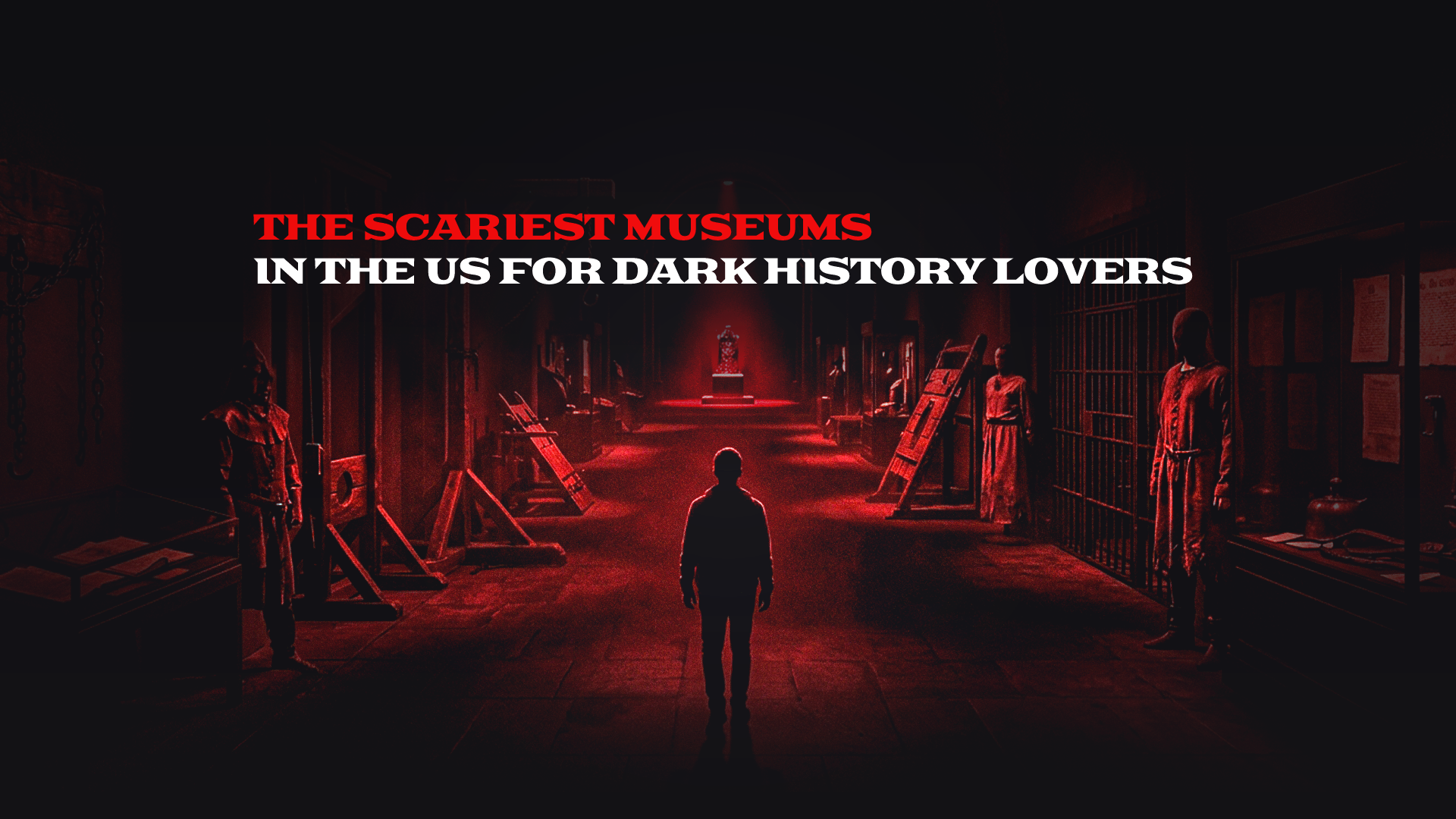
The Medieval Torture Museum is a good starting point if your idea of dark history centers on punishment, prisons, and the ways authorities used pain as control. It currently operates in Chicago, St. Augustine, and Los Angeles. The galleries use full-scale scenes, interactive displays, shackles, reconstructed torture devices, and recreated dungeon settings. An audio guide adds historical context to the objects and methods shown in the rooms.
I would treat the displays as historical interpretation rather than assume every device is an original medieval artifact. That distinction matters because many famous torture devices have complicated or weak provenance. The museum itself has recently discussed that problem in its material on the Judas cradle, noting the lack of surviving records proving its use in the form usually described today. Visitors should also expect graphic themes. The museum says admission is not recommended for people under 18 without an adult.
If this part of history interests you, you can visit Medieval Torture Museum and choose the location that fits your trip: Medieval Torture Museum official website. The museum currently lists locations at 177 N State Street in Chicago, 100 St. George Street in St. Augustine, and 6757 Hollywood Boulevard in Los Angeles.
2. Mütter Museum, Philadelphia, Pennsylvania
The Mütter Museum is disturbing in a quieter way. It is a medical-history museum run by The College of Physicians of Philadelphia, and many of its best-known displays involve human anatomy, disease, injury, and the history of medical study. The permanent Hyrtl Skull Collection contains 139 human skulls collected by anatomist Josef Hyrtl. The museum also displays the Soap Lady and the conjoined livers and plaster death cast of Chang and Eng Bunker.
These are not horror props. They are medical specimens, and the museum has spent recent years revising how it handles human remains, consent, provenance, and photography. Its current policy states that human remains will continue to be displayed with greater attention to their histories and provenance. That makes the Mütter one of the stronger macabre museums for readers who want medical history rather than theatrical horror.
The museum is at 19 S. 22nd Street in Philadelphia. It recommends advance tickets during busy weekend periods. The Mütter recommends the galleries for children aged 10 and older because parts of the collection show genitalia, traumatic injuries, and disfiguring medical conditions.
3. Museum of Death, Hollywood and New Orleans
The Museum of Death is the most directly graphic entry in this guide. It operates in Hollywood, California, and New Orleans, Louisiana. The two sites display death-related material such as coffins, skulls, mortuary equipment, crime and morgue photographs, graphic accident images, Manson Family photographs, and artwork or letters connected to serial murderers. The museum says the collections at its two locations contain different objects rather than duplicate displays.
This is closer to true-crime and death culture than a conventional history museum. That difference matters. Visitors come face to face with material connected to actual deaths, and some of the images are explicit. The museum warns that the content is intended for mature audiences, even though it does not set a general minimum age. Children must enter with a parent.
Both locations currently sell tickets in person rather than through advance online booking. The Hollywood museum is at 6363 Selma Avenue, while the New Orleans location is at 227 Dauphine Street. If you are sensitive to crime-scene photography or images of bodies, this is the place on the list where checking the content before arrival matters most.
4. The Warren’s Occult Museum Collection at Haunted Warren Museum, Salem, Massachusetts
The collection associated with Ed and Lorraine Warren has a new public home in 2026. The original Warren Occult Museum in Monroe, Connecticut, is not operating as a normal walk-in museum. Instead, a large part of the collection is now being shown at the Haunted Warren Museum at 259 Essex Street in Salem, Massachusetts. The Salem museum began welcoming the public in August 2026.
The best-known object is Annabelle, the Raggedy Ann doll that the Warrens described as demonically influenced. The museum also presents objects tied to the Warrens’ investigations and cases later used in popular horror films. This is where fact and claim must stay separate. The objects and their connection to the Warrens can be documented. Claims that an object is possessed, cursed, or capable of paranormal activity are matters of belief, not established historical facts.
The Salem museum offers self-guided flashlight visits and lists that experience for ages 12 and older. The current Salem run is advertised as temporary, with dates guaranteed through December 23, 2026 while a permanent location is developed. Anyone planning a later trip should confirm the museum’s location before booking travel.
5. National Museum of Funeral History, Houston, Texas
The National Museum of Funeral History is about death without trying to behave like a haunted attraction. Its Houston galleries examine funerary customs, embalming, cremation, hearses, coffins, presidential funerals, papal funerals, mourning practices, and traditions from several cultures. The museum currently lists 30,500 square feet of exhibition space and 19 permanent exhibits.
Some displays sound macabre when listed without context. There are historical embalming instruments, old hearses, caskets, mourning photography, and a recreation of an embalming station connected to Civil War-era practice. The museum also displays Ghanaian fantasy coffins and material about Japanese funerals, presidential funerals, cremation, and the history of mourning.
The overall approach is educational. The museum’s visitor guidance says the exhibits are not intended to be gruesome or spooky and generally recommends the museum for children older than seven. This makes it useful for people curious about death museums who do not want graphic crime photography or simulated violence. It is located at 415 Barren Springs Drive in Houston.
6. Salem Witch Museum, Salem, Massachusetts
The Salem Witch Museum deals with one of the darkest episodes in colonial New England, but it is important to separate the real trials from the Halloween imagery surrounding modern Salem. The museum’s main presentation uses 13 life-size stage sets, lighting, figures, and narration to explain the 1692 witch trials. A second exhibit, Witches: Evolving Perceptions, examines how the image of the witch changed over time.
The historical record is harsher than many popular retellings. No accused witch was burned at the stake in Salem. Nineteen people were hanged, while Giles Corey died after being pressed. The museum also explains that there is no contemporary evidence proving that the accused people actually practiced witchcraft. These distinctions matter when a historical tragedy has accumulated centuries of supernatural folklore.
In 2026 the museum added several artifacts to its permanent collection. They include a 1650 Bible concordance once owned by trial judge Samuel Sewall and a 1693 edition of Cotton Mather’s The Wonders of the Invisible World. The museum is at 19 1/2 Washington Square North. Its presentations use timed admission, and visitors should expect especially heavy demand during October.
7. International Cryptozoology Museum, Bangor, Maine
The International Cryptozoology Museum belongs on any serious list of weird museums in the US, but it needs a different fact-checking standard from a medical or funeral museum. Cryptozoology deals with reported or legendary animals whose existence has not been established by mainstream zoology. The museum covers Bigfoot, the Yeti, lake monsters, the thylacine, and other cryptids alongside stories of animals once considered surprising discoveries.
The collection includes footprint casts, expedition material, sculptures, models, and hair or biological samples attributed to various cryptids. Those objects are real collection items. Their presence does not prove that the creatures attached to their stories exist. One useful counterpoint is the museum’s life-size coelacanth model, referring to a fish known from fossils before a living specimen was documented in 1938.
The practical detail many older travel articles now get wrong is the address. The International Cryptozoology Museum moved from Portland and opened its new home at 490 Broadway in Bangor on June 1, 2026. The museum states that its former Portland location and earlier Bangor address are permanently closed.
8. Glore Psychiatric Museum, St. Joseph, Missouri
The Glore Psychiatric Museum documents the history of psychiatric treatment through hospital history, patient material, art, equipment, and reconstructed treatment devices. It occupies a former medical building connected to St. Joseph State Hospital, originally established as State Lunatic Asylum No. 2 in 1874. The setting gives the collection a direct connection to the institution whose history it explains.
One detail prevents the museum from turning into a simple cabinet of horror stories. Many of its old treatment devices are replicas, not surviving seventeenth- or eighteenth-century machines. George Glore and other hospital staff built full-size reproductions in 1968 for a Mental Health Awareness Week program. Those reconstructions later became a central part of the museum.
The collection also includes patient-related artifacts. Missouri’s Department of Mental Health notes an exhibit containing 1,446 objects removed from one patient’s stomach in 1929. The museum is now part of the St. Joseph Museum complex at 3406 Frederick Avenue. General admission also provides access to other collections at the same site.
9. International Museum of Surgical Science, Chicago, Illinois
The International Museum of Surgical Science is less graphic than the Mütter Museum, but its subject can still make some visitors uncomfortable. The museum occupies four floors of a historic mansion on Lake Shore Drive and covers the development of surgery, anatomy, imaging, dentistry, nursing, pain treatment, and medical technology. It maintains more than 10,000 square feet of public galleries devoted to surgical and medical history.
The darker material comes from the history of treatment itself. Galleries include a nineteenth-century apothecary, an early dental office, displays on polio and the iron lung, anatomical illustration, obstetrics and gynecology, pain management, and surgical technology. The museum’s purpose is educational rather than sensational. Its displays show how medicine changed through failed methods, technical advances, experimentation, and improved understanding of the body.
The museum is at 1524 N. Lake Shore Drive in Chicago and currently opens seven days a week. Families can visit, and the museum publishes accessibility information for wheelchairs and strollers. Parents can check current exhibition descriptions before bringing children who are particularly sensitive to medical imagery.
10. Eastern State Penitentiary Historic Site, Philadelphia, Pennsylvania
Eastern State Penitentiary is technically a historic site rather than a conventional museum, but it belongs in a dark-history itinerary. The former prison began as a nineteenth-century experiment in penitentiary design and prison reform. Today, visitors walk through preserved cellblocks while exhibitions explain the institution, the people held there, and the wider history of incarceration in the United States.
The daytime experience is history-focused. Admission includes an audio tour, guide-led options, exhibitions, art installations, and points of interest such as Al Capone’s restored cell. Current displays also connect Eastern State’s history with the modern American prison system. That gives the site more substance than a spooky abandoned-building stop.
The distinction matters in autumn. Eastern State also runs Halloween Nights, a separate seasonal program with haunted houses and entertainment. The theatrical Halloween event and the daytime historic site are different experiences. For the historical visit, go to 2027 Fairmount Avenue in Philadelphia and reserve online if you want a specific guided-tour time.
Why We Love Dark Museums
Dark museums give physical form to subjects that are easy to keep abstract. You will look differently at a paragraph about early surgery that is for sure. You might not belive it had happened when you see the scale of a restraint or enter a reconstructed cell for the first time. Funeral history becomes less mysterious when hearses, mourning objects, embalming equipment, and coffins are treated as material culture rather than props.
I also like these museums because they force a useful distinction between evidence and story. The Salem witch trials are documented history, while the supernatural accusations made during them were not proven facts. The Warren collection contains physical objects, but claims that those objects are haunted remain paranormal claims. Cryptozoology museums preserve reports and alleged evidence, but a footprint cast does not establish the existence of Bigfoot.
That separation makes the best creepy museums more interesting, not less. A museum does not need to certify every legend to explain why people believed it, feared it, collected it, or built stories around it. The same principle applies to torture displays. A reconstruction can teach something valuable when it is identified as a reconstruction and the history behind it is documented.
For dark-history readers, that is the appeal. These places deal with death, pain, medicine, punishment, belief, and fear without requiring every story to become a ghost story.