I’ve spent years reading interrogation records, warrants, and prisoner accounts from the Tower of London, and the rack torture keeps coming up as the device everyone recognizes but almost nobody can actually describe. People picture something vague and medieval. Ropes, maybe a wheel, a scream in a dungeon. The real mechanism is simpler than that, and grimmer once you understand it.
What the rack was and how it worked
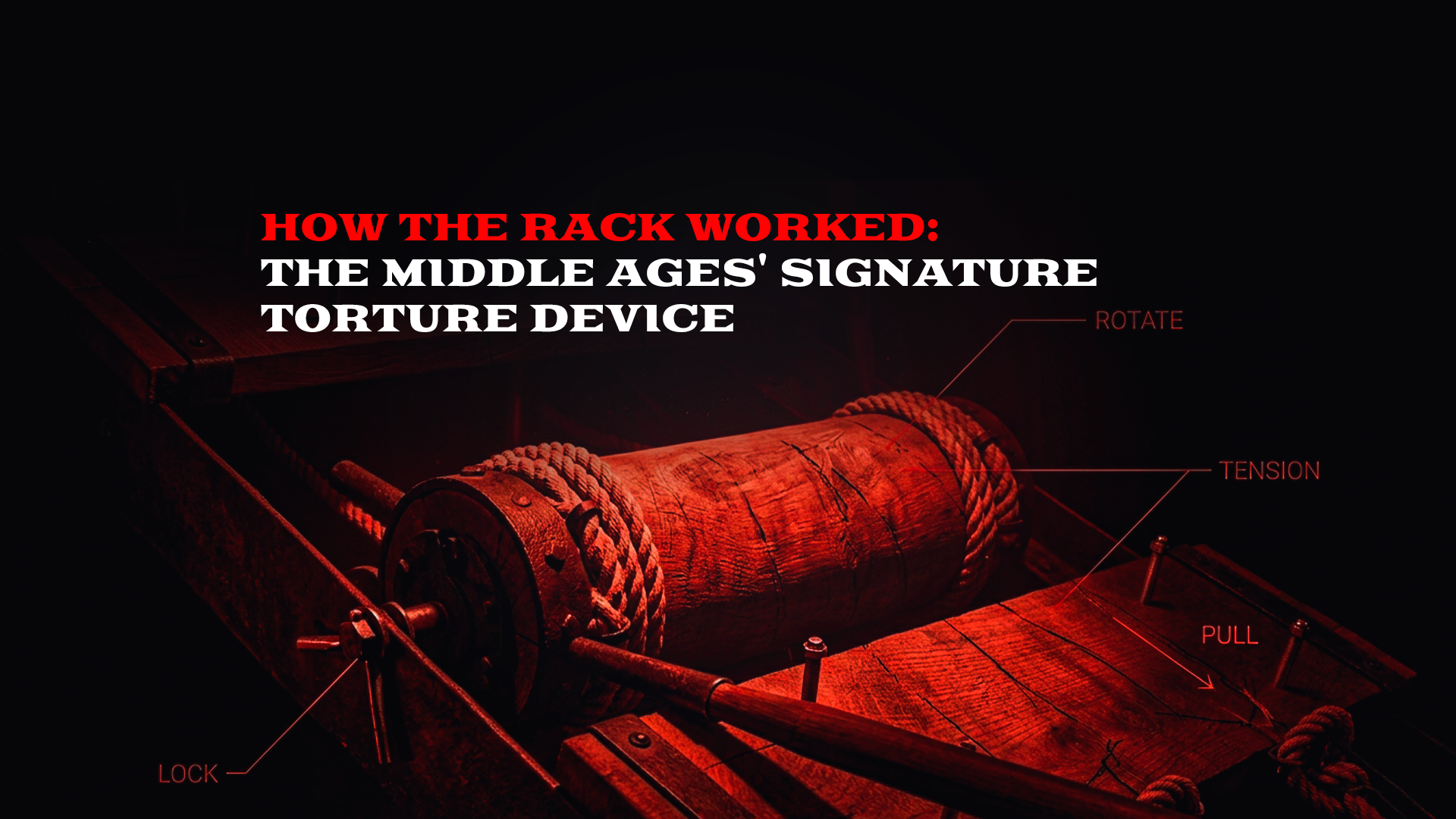
The rack was a wooden frame with a roller at each end. A prisoner’s wrists were tied to one roller and their ankles to the other, and a handle-and-ratchet system slowly wound the rollers apart. Each turn stretched the body a little further, straining muscles first, then tearing ligaments, then pulling joints out of their sockets. It wasn’t a quick device. Sessions could stretch out over hours, sometimes across several days, with questioning happening between turns of the crank.
The Mechanics of the Rack Torture
A rack was built to do one job: pull a human body apart at a controlled, gradual pace. The frame itself was a rectangular wooden table, raised slightly off the ground on short legs. At each end sat a roller, essentially a heavy wooden cylinder that could rotate. Ropes or chains ran from the rollers to cuffs at the prisoner’s wrists and ankles.
The person operating the rack turned a handle connected to a ratchet. A ratchet only moves one way, which meant that once the rollers had wound in a few inches of rope, they couldn’t be wound back out. Every turn locked in place. That detail mattered enormously, because it meant the pain only ever increased during a session. There was no slack to offer, no easing off, unless the operator chose to stop cranking entirely.
The first few turns pulled the prisoner’s limbs taut and put steady tension on the muscles and tendons. This alone was agonizing, but it was just the opening stage. As the rollers kept turning, the strain moved into the joints themselves: shoulders, hips, elbows, knees. Ligaments, which hold joints together and aren’t built to stretch far, began to tear. Eventually the joints separated, sometimes audibly, and the limbs could dislocate completely.
Muscle tissue that’s stretched too far also loses its ability to contract properly, which is part of why survivors of the rack often couldn’t stand or walk afterward, even once the ropes came off. Anne Askew, tortured on the rack in 1546, was so badly damaged that guards had to carry her to her own execution in a chair. That single detail tells you more about how the rack actually worked than any dramatic description could.
Operators sometimes combined the stretching with other cruelties, applying burning torches to the sides or armpits, or sliding hot coals between the prisoner’s toes, to intensify the pain without touching the ratchet. The rack wasn’t designed to kill outright. It was built to produce unbearable, escalating pain while keeping the victim conscious and able to speak, because the entire point was extracting a confession or a name.
History & Use of the Medieval Rack
The rack shows up earlier than most people expect, long before it became a fixture of English interrogation rooms. Ancient Greek sources describe stretching devices used on slaves and prisoners as far back as the fourth century BC, including the torture of Herostratus, the man who burned down the Temple of Artemis at Ephesus in 356 BC. Alexander the Great reportedly had conspirators racked in 328 BC, and the Roman writer Tacitus describes a similar device, the equuleus, used in 65 AD against a freedwoman named Epicharis, who was suspected in a plot against Emperor Nero. She refused to give names even after her joints had been dislocated, and strangled herself with a cord rather than face the rack again.
In England, the rack medieval torture era really begins in 1447, when John Holland, the second Duke of Exeter and constable of the Tower of London, is credited with introducing it there. That’s why the device picked up the nickname “the Duke of Exeter’s daughter,” a grim little joke among the men who used it. For a while, England reserved the rack for cases of suspected treason and heresy, and only with direct royal or Privy Council authorization. It wasn’t something local courts could simply order.
Use of the rack in England peaked during the religious conflicts of the 1500s and early 1600s, when Catholic and Protestant monarchs took turns persecuting each other’s followers. Anne Askew’s case, mentioned above, came during Henry VIII’s reign. Decades later, the Jesuit lay brother Nicholas Owen, famous for building hidden priest holes to shelter Catholic clergy, died under torture on the rack in the Tower in 1606. He never gave up a single name.
The most famous case by far is Guy Fawkes, arrested on 5 November 1605 after the Gunpowder Plot to blow up Parliament was uncovered. A surviving royal warrant from King James I instructs interrogators to start with “the gentler tortures” and escalate step by step if Fawkes stayed silent, with the rack as the final option. Compare his signature on documents from before his arrest with the one on his confession, signed a few days later, and the difference is stark. The earlier signature is confident and legible. The later one is a shaky, barely-formed scrawl, consistent with someone whose hands had been badly damaged.
Legal pushback against the rack started building through the early 1600s. In 1628, the Privy Council considered racking John Felton, who had assassinated the Duke of Buckingham, and England’s judges unanimously refused, declaring the practice contrary to English law. Torture in England was always something of a legal gray area, authorized case by case rather than written into common law, and by the mid-1600s that gray area had effectively closed. If you want to see where much of this took place, the Tower of London itself still runs exhibits on the subject, and walking through the White Tower gives you a real sense of the space these interrogations happened in.
The Rack vs. Other Stretching Devices
The rack wasn’t the only device built around pulling the body apart, but it worked on a different principle than most of its rivals. The strappado, widely used across continental Europe and by the Spanish Inquisition, worked by suspension rather than mechanical winding. A prisoner’s wrists were tied behind their back, then hoisted up by a rope, dislocating the shoulders under the body’s own weight. Sometimes the torturer added a sudden drop partway down, which could tear the joints even more violently.
The Scavenger’s Daughter, invented under Henry VIII by Sir Leonard Skeffington, did almost the opposite job. Instead of stretching the body outward, it folded a prisoner into a tight crouch inside an A-frame, compressing the spine and chest until blood was forced from the nose and ears. Historians sometimes describe it as the rack’s structural opposite: one device pulled you apart, the other crushed you into a ball. Both caused catastrophic joint and tissue damage, just from opposite directions.
What set the rack apart mechanically was its ratchet-driven precision. A strappado session depended on gravity and a rope; the rack let an interrogator control the exact pace of the pain, turn by turn, and pause at any point to ask questions. If you’re planning historical travel around this topic, museums in Amsterdam and Nuremberg both hold surviving examples of stretching and compression devices from this period, and comparing them side by side makes the mechanical differences much clearer than reading about them.
Myths & Misconceptions About Rack Torture History
The biggest misconception is timing. Despite constant references to “medieval” torture and appearances in films like Braveheart, the rack likely wasn’t used in England until the very end of the medieval period, arriving in 1447 and only becoming common in the following century. Most of its documented English use falls squarely in the Tudor and early Stuart periods, which historians classify as early modern, not medieval. The word “medieval” gets attached to it mostly because it feels appropriately old and grim, not because the dates line up.
Another persistent myth is that the rack was an everyday tool of village justice, used casually against ordinary criminals. In England, it was the opposite: a rare, tightly controlled instrument requiring authorization from the monarch or Privy Council, reserved almost exclusively for treason and heresy cases where the state wanted names of other suspects. Most accused criminals in this period never came anywhere near a rack. Popular culture tends to flatten this distinction, lumping the rack in with a long list of exaggerated or entirely invented devices, the same way later writers invented dramatic backstories for devices like the iron maiden, which historians now believe was largely an 18th- and 19th-century fabrication built for museum display rather than a genuine medieval tool.
There’s also a common assumption that the rack was primarily a killing device. It wasn’t, at least not by design. Interrogators wanted a confession or a name, and a corpse can’t give either. That said, the rack could and did kill, whether through shock, internal injury, or a slow decline afterward, and Nicholas Owen’s death under torture in 1606 is direct proof of that risk. The device operated in a narrow, dangerous margin between “enough pain to break someone” and “damage severe enough to kill them,” and that margin wasn’t always respected.
See the Rack Torture Device Up Close
Reading about the mechanics is one thing. Standing next to a full-scale reconstruction, seeing the actual size of the rollers and the length of chain between the cuffs, changes how the whole device registers. It stops being an abstract historical fact and becomes a piece of engineering built with a very specific, very human purpose in mind.
That’s exactly what you’ll find in our collection. See the Rack replica at the Medieval Torture Museum, alongside detailed panels covering how it was built, who operated it, and the documented cases where it was used. We’ve built the exhibit around verified historical sources rather than the exaggerated versions you’ll find in films or pop history lists, which fits the wider approach of this blog: separating what’s actually documented from what’s been invented for effect. If you’re in the area, it’s worth the visit. You can plan your trip at the Medieval Torture Museum.