The Judas cradle is often presented as a symbol of historical interrogation. Its pyramid-shaped image is striking, but an image, a label and a reconstruction are different kinds of evidence from a dated trial record. This guide explains how to keep those categories separate when reading about the Inquisition.
For a concise introduction to the object itself, read what the Judas cradle is and how it is represented. This article examines the wider evidence for interrogation procedures and why a museum label alone cannot establish a device’s use by the Inquisition.
What the Spanish Inquisition actually was
“The Inquisition” does not describe one unchanged institution across every period and place. The University of Notre Dame’s Inquisition collection distinguishes Spanish, Portuguese, Roman and other contexts, with manuals, trial records and polemical works among its sources. Claims about a device should identify which context and which kind of evidence they concern.
The Rules of Inquisitorial Torture
Inquisitorial torture operated under formal legal limits, at least on paper. Interrogators weren’t supposed to draw blood, break bones, or cause permanent injury, since canon law framed torture as a tool for extracting truth rather than a punishment in itself. Sessions were meant to be brief, and a suspect legally couldn’t be tortured more than once for the same charge.
That one-session rule sounds like real protection until you see how inquisitors got around it. If a suspect didn’t confess, officials could suspend the interrogation and resume it later under the label of a “continuation” rather than a new session, sidestepping the ban on repeat torture entirely. This wasn’t a secret loophole either. It shows up plainly in surviving Inquisition procedural manuals, treated as standard practice rather than an exception.
The legal reasoning behind this workaround came straight from Roman-canon law, the same tradition that shaped secular courts across continental Europe. Torture wasn’t classified as punishment under this system. It was classified as a method of gathering evidence, specifically a confession, which meant the rules governing it focused on procedure rather than on protecting the suspect. A “continuation” of an unfinished interrogation didn’t count as a new instance of torture in the eyes of the law, even if the suspect experienced it as one continuous, unbroken ordeal.
Notaries played a strange, central role in all of this. Every interrogation session required a notary present to record the proceedings word for word, including the suspect’s statements and any confession extracted along the way. That written record mattered enormously later, since a confession given under torture technically had to be voluntarily repeated afterward, away from the torture chamber, for it to hold up as valid evidence. In practice, suspects understood exactly what would happen if they retracted their statement during that later repetition, so the “voluntary” confirmation rarely differed from what had already been said under duress.
Time limits worked the same way. A session was supposed to stop after a set period, often measured in an hour or so, but notaries recording the proceedings sometimes simply paused the clock on paper while the interrogation continued in the room. The written record could show a short, restrained session even when the actual ordeal ran much longer. Rules existed, and inquisitors mostly still found ways around them when they wanted a confession badly enough.
Medical presence, at least in theory, was supposed to add another layer of restraint. Some Inquisition tribunals required a physician to be on hand during interrogations, tasked with judging whether a suspect’s health could withstand further questioning. In practice, this safeguard depended entirely on how seriously an individual physician took the role, and surviving records suggest plenty of variation from one tribunal to the next. A cautious doctor might halt a session early. A more compliant one might simply confirm whatever outcome the inquisitors already wanted.
Confessions extracted this way carried real legal weight regardless of how they were obtained, which is part of what made the whole system function the way it did. Once a suspect confessed, whether from genuine guilt or from unbearable pain, the case moved toward sentencing rather than further investigation. That created an obvious incentive structure. A confession ended the ordeal, at least in the interrogation room, even if it meant admitting to something the suspect hadn’t actually done.
Not every tribunal applied these rules with equal severity, either. Regional Inquisition offices across Spain and its territories operated with a fair amount of local discretion, and surviving records show real variation in how strictly the formal limits were followed from one jurisdiction to the next. Some inquisitors leaned on torture routinely as a first resort. Others reserved it for cases where other evidence had already stalled, treating it as a last option rather than a standard step in every interrogation.
The Devices
The Judas Cradle
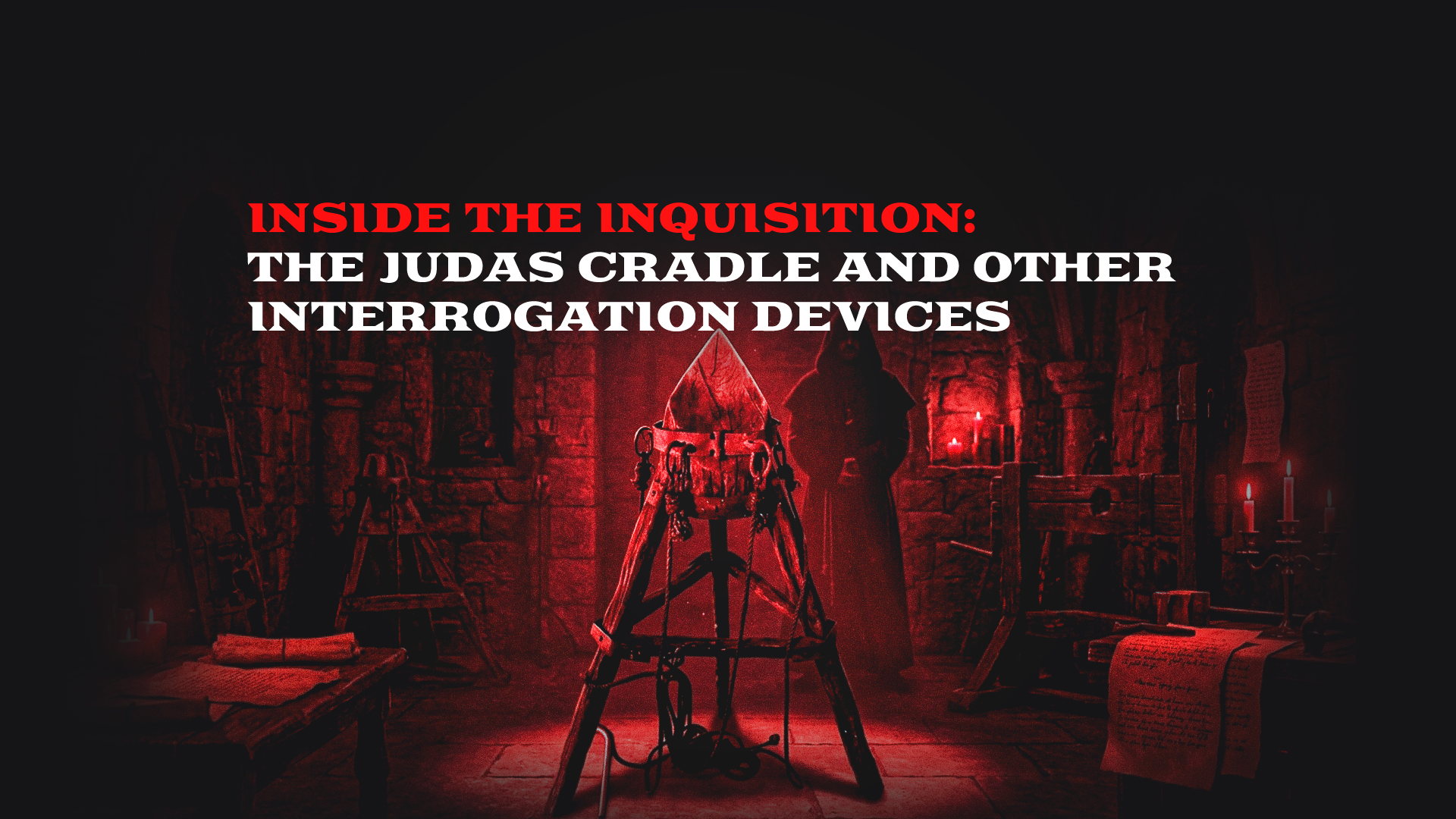
Popular representations show a pointed pyramidal seat and a bound figure. That representation is not, by itself, evidence of its use in an Inquisition tribunal. This article does not establish a dated court case or authenticated object that would verify the familiar impalement narrative.
Claims that the device evolved from a particular sleep-deprivation stool also require a traceable source. An attractive explanation should not replace one unverified origin story with another.
For its name, design and comparison with the rack, see our Judas cradle overview. The relevant question here is what a specified document demonstrates about a particular practice.
Strappado
Strappado, called garrucha in Spanish records, was one of the Spanish Inquisition’s three officially sanctioned methods, and it’s extremely well documented. Interrogators bound a suspect’s hands behind their back, then hoisted them by a rope tied to those wrists, sometimes adding a sudden drop partway through to add a jolt of dislocation on top of the strain.
This method fit the “no blood, no broken bones” rule on its face, since it caused catastrophic joint damage without visibly marking the skin. That’s likely part of why inquisitors leaned on it so heavily. Court records describe repeated use across Spain and its territories, with specific suspects, dates, and outcomes recorded in enough detail that historians can reconstruct actual interrogation sessions from the paperwork alone.
The Water Torture (Toca)
The toca forced water into a suspect’s mouth and throat using a cloth held in place over the face, creating a sensation of drowning while remaining, technically, within the “no bloodshed” rule inquisitors operated under. Officials draped the cloth over the suspect’s mouth and nose and poured water steadily, which the suspect had to swallow or choke on, sometimes prompting confessions within minutes purely out of panic.
The toca stands out because it required almost no specialized equipment, just water, cloth, and a restrained suspect, which made it easy to administer in nearly any interrogation setting. Spanish Inquisition torture devices didn’t need to be elaborate machinery. Some of the most consistently used methods relied on ordinary household materials turned toward a specific, brutal purpose.
Descriptions from surviving trial records give a sense of how deliberate the process was. Officials sometimes used multiple jars of water in a single session, pausing between each to give the suspect a chance to speak before continuing. The sensation of controlled drowning, repeated in measured intervals, made the toca one of the more psychologically calculated methods on this list, designed to produce panic and desperation rather than sheer physical damage.
The Rack (Potro)
The potro stretched a bound suspect’s limbs using ropes tightened around a wooden frame, gradually pulling the joints toward separation as an interrogator turned a windlass to increase tension. Officials could dial the pressure up or down in real time, which made it useful for a slow, escalating interrogation rather than a single decisive shock.
Spanish court records describe the potro in enough procedural detail that historians know roughly how sessions were structured, including how notaries recorded a suspect’s statements as the tension increased. That level of documentation is exactly what’s missing from the Judas cradle. The rack left a paper trail because it was a routine, legally sanctioned tool, used often enough that clerks developed a standard way to write it up.
Cords tied at specific points on the body, usually the arms and legs, dug into flesh as the ropes tightened, adding a secondary source of pain on top of the joint strain itself. Interrogators could increase or ease pressure gradually, turn by turn, which gave the potro a reputation as one of the more controllable methods on this list. That control is precisely why it appears so often in the documentary record. A method that could be paused, adjusted, and resumed left plenty of opportunities for a notary to record exactly what was happening at each stage.
Thumbscrews
Thumbscrews clamped a suspect’s fingers between metal plates tightened by a screw, building pain gradually rather than all at once. They appear across various European interrogation contexts, though their connection to the Spanish Inquisition specifically is less firmly established than strappado, the toca, or the potro.
That distinction matters for understanding inquisition torture methods accurately. Thumbscrews were a common tool across secular and ecclesiastical courts throughout medieval and early modern Europe, but the Spanish Inquisition’s own procedural records center on the three methods above. Thumbscrews may well have been used in some Inquisition contexts, but they don’t carry the same weight of direct documentation.
The gap between well-documented and loosely-attributed devices tends to follow a pattern worth noticing. Methods that required specific procedural steps, repeatable and easy for a notary to describe consistently, show up again and again in the archives. Devices without that procedural structure, or ones borrowed loosely from a broader European torture tradition, tend to appear more as passing mentions or later assumptions than as documented Inquisition practice.
Myth vs. Reality: How Real Is the Judas Cradle?
A historical claim is easier to assess when an account identifies its author, date, place and relation to the event. A later depiction may be useful for studying popular beliefs without being a contemporary record of a device’s use.
The McDevitt Inquisition Collection separates trials and sentencing, inquisitorial manuals, and polemics and histories. Those categories ask different questions of the reader. A polemical illustration should not be treated as interchangeable with a court’s procedural record.
That distinction supports careful discussion of torture without requiring certainty about every familiar object in a modern display.
See the Documented Devices for Yourself
The Medieval Torture Museum offers modern displays about punishment and dark history. A visit can prompt questions about what is documented, what is reconstructed and how the subject is interpreted. Check the official Chicago visitor information for current content and age guidance before planning a visit.
If this kind of history interests you, I’d recommend seeing it in person and asking questions about what’s documented and what isn’t. A good exhibit should be honest about that distinction rather than blurring it for effect. You can plan a visit and check current exhibits at the Medieval Torture Museum.