
I’ve spent years going through court records, museum catalogs, and the occasional very dry Latin legal text, just to answer one question: which medieval torture devices were actually real. A lot of what you see online and in gift shops is guesswork dressed up as history. Some of it is outright invention from three hundred years after the Middle Ages ended.
This is an honest list. I’ll walk you through the devices that show up in real trial records and museum collections with solid provenance, and I’ll flag the ones that were exaggerated or built later to shock tourists. By the end, you’ll know exactly which is which, and where you can go see the real thing for yourself.
What were the most common medieval torture devices?
The most documented medieval torture methods relied on simple mechanical force.
- The rack,
- Thumbscrews
- The strappado
- The breaking wheel
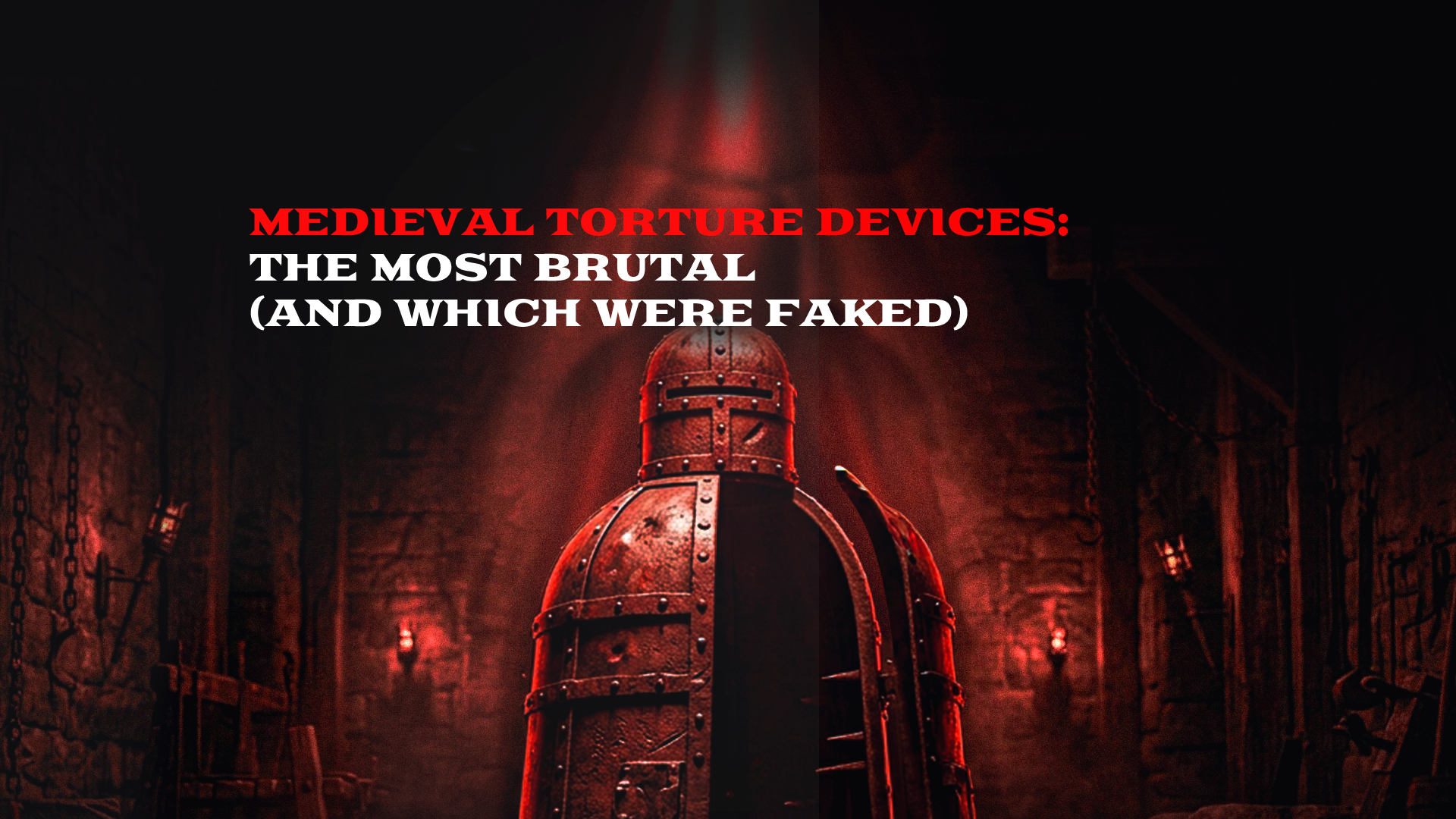
These devices worked by stretching, crushing, or dislocating the body, and courts used them mainly to extract confessions rather than as standalone punishments. Famous “spiked cage” devices like the Iron Maiden are not part of this documented list; they’re 19th-century fabrications, which I’ll explain further down.
How torture actually worked in the Middle Ages
Torture in medieval Europe was a legal procedure, not random cruelty. Roman law had allowed judicial torture of slaves as evidence, and when European courts revived Roman legal principles starting in the 12th century, they brought this practice back with them. By the 13th century, inquisitorial courts across much of continental Europe used torture as a recognized way to secure confessions.
The goal was almost always a confession, since medieval law placed enormous weight on a defendant admitting guilt. Courts generally required either two eyewitnesses or a confession to convict someone of a serious crime. Circumstantial evidence alone often wasn’t enough. That legal gap pushed judges toward torture as a shortcut to the confession the system demanded.
Church and secular courts split the work differently depending on the country and century. Secular courts handled most criminal torture. Church courts, including the Inquisition, focused on heresy and used their own rules, which usually limited sessions to one round unless new evidence appeared. Contrary to popular belief, the Catholic Church did not run torture chambers stocked with novelty machines. Canon law even restricted clergy from directly drawing blood, which is one reason officials often handed the physical work to secular executioners. Secular courts varied by region: some, like those in parts of Germany and France, used medieval torture instruments as a standard step in serious criminal cases, while England relied on it far less and only under royal warrant.
Confessions obtained under torture carried real legal risk, and medieval jurists knew it. Many required a defendant to repeat the confession freely, away from the torture chamber, before it could be used at trial. That rule existed precisely because judges understood people say anything to make pain stop. It didn’t eliminate wrongful confessions, but it shows the system wasn’t as careless about truth as popular history assumes.
Class and status mattered too. In much of medieval Europe, nobles, clergy, and citizens with certain legal privileges were formally exempt from torture, or could only be questioned under it in the most serious cases, such as treason. That left the practice falling hardest on peasants, servants, and anyone without connections or money to argue for an exemption. Some city law codes went further and capped how many sessions a court could order, or required a physician to be present, which tells you officials were at least aware of how easily the process could kill someone before a verdict was reached.
The specific method used also varied by region and by what the local court had on hand. A wealthy city with a standing prison might maintain a rack and a dedicated chamber. A smaller rural jurisdiction more often relied on rope, a beam, and whatever restraint tools the local blacksmith could produce, which is one reason simple methods like strappado and thumbscrews left a much wider paper trail than elaborate machinery.
The devices
Here’s the core list. Each one has documented use in medieval or early modern Europe, backed by trial records, museum holdings, or period illustrations.
The Rack
The advent of the rack comes from British Constable John Exeter who invented the device in 1447 for the torture of prisoners of the Tower of London (initially it was called the “Duke of Exeter’s Daughter”.
The operating principles of this sinister mechanism centers on the torque that stretches the joints and tears muscle ligaments. The accuracy and ease of the rack’s design made it the most commonly-used instrument of torture of its day. It consisted of a wooden table with rollers at either end to which ropes were tied. Later on, the French would slightly modify the rack’s appearance, adding an additional mechanism — metal rollers with spikes that sliced into the skin and muscles of the victim’s back.
Any criminal or deviant could could be sentenced to torture via the rack. After such a verdict, they were laid on the table, wrists and ankles bound with ropes, and slowly stretched in opposing directions. The advantage to this torture method was its extremely precise control over the impact of pain. The tension could be increased, attenuated, and then enhanced by twisting the victim’s joints, and eventually, tearing the muscles and the nerves apart. After a few hours spent on the rack, any man would remain crippled for life.
The Breaking Wheel
This type of punishment was derived from ancient Rome and is considered one of the most severe form after the quartering. During the Middle Ages its use spread throughout Europe, invoking terror in criminals until the XIX century.
The cruelty of the penalty was combined with the public humiliation of the offender. The body of the victim was tied to a horizontal-arranged wheel so that the head was turned up towards the sky, with the limbs resting on needles. Then the executioners beat the unfortunate soul to near-death with an iron bar. The bones in said limbs were crushed in two places, and two or three hits to the stomach and the bludgeoning of the backbone finishes off the procedure. The offender, now thoroughly maimed, was place on the wheel in a way that his heels had come together at the back of his head. His bleeding body was left to die in this position. The agony could last several days, and the bodies were often fed to carrion birds.
An interesting fact: In the year 1348, during the Plague, a Jew by the name of Bona underwent this punishment and was tortured for four days and four nights. It was the longest known survival of the Wheel in the history of its existence.
Thumbscrews
Thumbscrews compressed a person’s fingers or thumbs between two metal bars tightened with a screw. They were small, portable, and required no special setup, which made them a common tool for both interrogators and traveling courts.
Records from Scotland and Germany describe thumbscrews used specifically to extract testimony before moving to harsher methods. Their simplicity is exactly why so many originals survive in museum collections today.
The Judas Cradle
The invention of this instrument is attributed to the Italian executioner Ippolit Marsili. It appeared in the late 15th century, and was used to torture heretics and potential sorcerers for several centuries.
A device is a heavy wooden pyramid that rises up on all fours, like a chair. With the aid of rope and gears, the one accused was hung naked and slowly lowered directly onto the surface of the point. The torturers used the natural force of gravity to affect the most sensitive area of the human body – the perineum region. An interesting fact: Among other instruments of torture that were invented in the Middle Ages, the “Cradle of Judas” was considered humane and was originally only intended to disturb sleep.
Scavenger’s Daughter
This tool of torture was invented during the reign of Henry VIII (early 16th century). The invention is attributed to the commandant of the elite English prison, Leonard Scaffington.
The device was actively used for the noble prisoners of the Tower of London. The principle of the instrument – fixing the neck and limbs with metal staples, and keeping the offender in an extremely uncomfortable position for a long period of time.
The Pear of Anguish
The so-called Pear of Anguish was supposedly inserted into a body cavity and expanded using a screw mechanism. You’ll see it described online as a common worst torture device from the period, but the historical record doesn’t back that up well.
Most surviving examples trace to 19th-century collections rather than documented medieval use, and there’s no solid trial record describing it in action. Some historians argue it may have originated as a gag or a different tool entirely before later collectors reinterpreted its purpose. I’m listing it here because it’s often grouped with the devices above, but treat its “torture” function as unconfirmed rather than established fact.
Head Crusher
The head crusher used a metal frame and a screw-driven cap to compress the skull, typically starting with pressure on the jaw and teeth before moving upward. Unlike the Pear, this device has better documentation, with surviving examples showing consistent design across multiple regions.
It appears in inventories from courts in the Holy Roman Empire and was generally used for interrogation rather than execution, since the goal was applying escalating pain rather than immediate death.
The Brazen Bull (ancient, not medieval)
The Brazen Bull doesn’t belong to the medieval period at all. It’s credited to ancient Sicily, built for the tyrant Phalaris of Agrigone in the 6th century BCE, roughly 1,500 years before anything we’d call medieval. Victims were sealed inside a hollow bronze bull and a fire was lit beneath it.
I’m including it because it gets lumped in with medieval torture lists constantly, and that’s simply a timeline error worth correcting. If you see it presented as a medieval device, that’s your signal the source hasn’t checked its dates.
The Saw
A style of punishment which was popular in medieval Europe, as well as some Asian countries. This presents itself as an extremely simple and cheap method of killing a victim accused of witchcraft, adultery, murder, blasphemy, or even theft.
In the Roman Empire they sawed their victims in half, horizontally. The more inventive Chinese decided to hang offenders vertically by their feet between two stakes which had been driven in the ground.
There is documentary evidence of brutal massacre by sawing of members of Hussite movement in the Czech Republic in 15th century.
Strappato
Strappato, sometimes called the “strappado,” bound the victim’s hands behind their back before hoisting them by a rope attached to the wrists. The weight of the body pulled the shoulders from their sockets, and interrogators sometimes added sudden drops to intensify the dislocation.
This was one of the most widely used medieval torture methods specifically because it required minimal equipment: a rope and something to hoist it over. Inquisitorial courts across Europe relied on it heavily, and it’s one of the best-documented methods in surviving trial transcripts.
Which “devices” were faked or exaggerated
Two names come up constantly in list of medieval torture devices articles, and both deserve real scrutiny:
- The Iron Maiden
- The Pear of Anguish.
The Iron Maiden, the spiked cabinet shaped like a body, has no medieval documentation at all. Historians trace its modern fame to 18th and 19th-century Germany, where examples were assembled, sometimes from unrelated older armor pieces, specifically for exhibition.
The Pear of Anguish falls into a similar category, as I mentioned above. Its dramatic reputation as a real medieval torture device used for specific punishments largely comes from 19th-century collectors and showmen who needed a compelling story for visitors, not from court documentation.
Both objects tell you something useful: the 19th century had a huge appetite for shocking exhibits, and museums and private collectors were happy to supply it, accurate history or not.
Where to see authentic replicas today
If you want to see these devices without wading through unreliable sources, going to a museum built specifically around documented history is the most reliable option. The Medieval Torture Museum focuses on exactly this kind of fact-checked presentation, separating verified devices from later fabrications the same way I’ve done in this article. If you’re in the area, it’s worth a visit to see authentic replicas of these devices at the Medieval Torture Museum.
The museum walks you through devices like the rack, the breaking wheel, and strappado with detailed context on how courts actually used them, alongside the fabricated pieces like the Iron Maiden, explained honestly as 19th-century additions to the legend. If you’re near Chicago, St. Augustine, or Los Angeles, it’s worth a stop, especially if you’ve read this far and want to see the mechanics in person rather than just picture them.