
I spend a lot of time digging into the darkest corners of human history, and one thing you learn fast is that people have always been creative about inflicting pain. Every so often, though, a method surfaces online that sounds too engineered, too precisely cruel to be real. That’s usually how people first hear about scaphism. It makes the rounds on Reddit and history forums as the worst way a human being could possibly die, always with the same vivid details: boats, milk, honey, insects. Once you look past the viral posts and into the actual historical record, the story gets a lot more complicated.
What is Scaphism
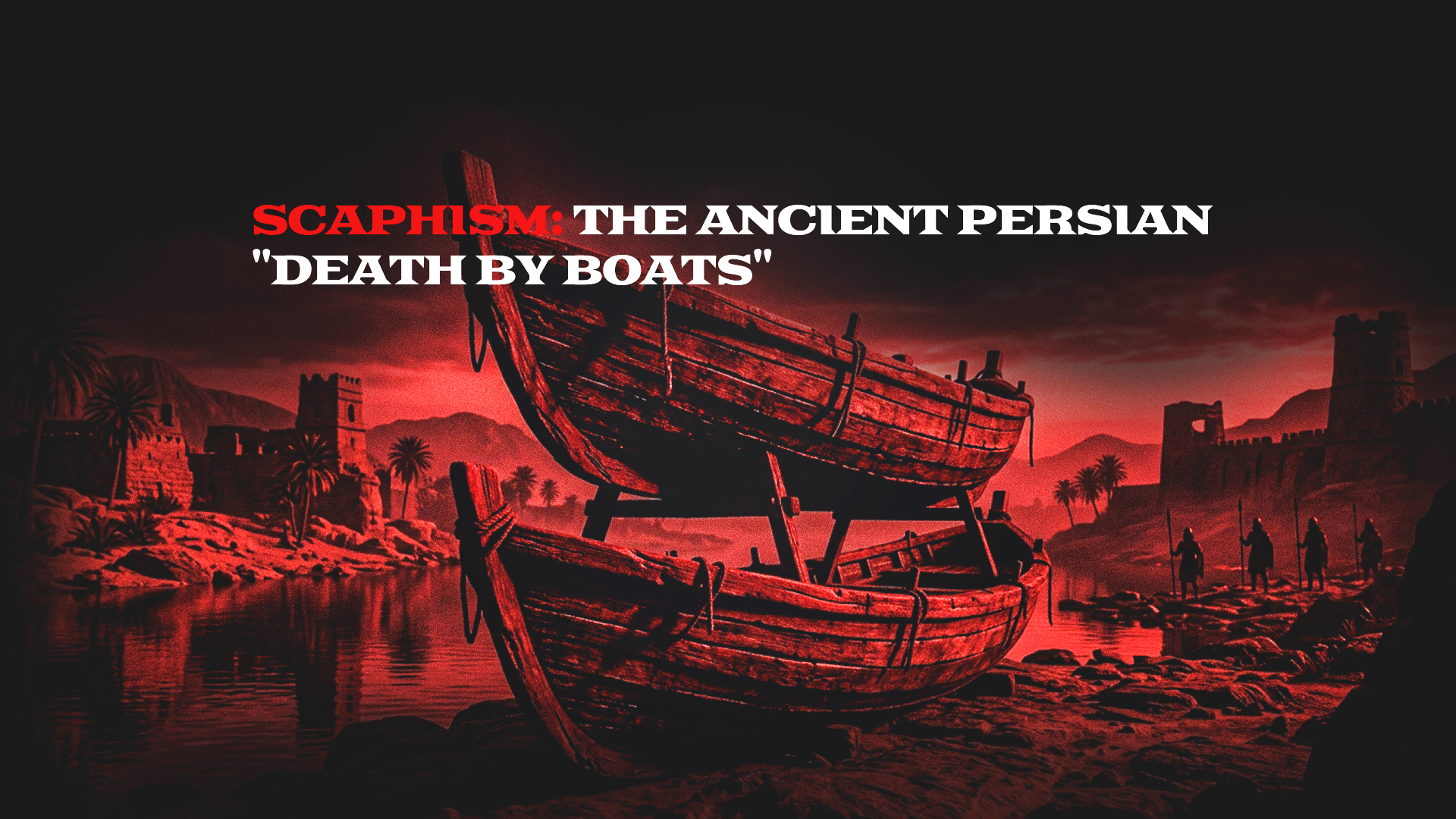
Scaphism was an alleged ancient Persian execution method in which a victim was trapped between two hollowed-out boats, force-fed milk and honey, and left exposed in a stagnant pond. The sweet food, mixed with the victim’s own waste, drew swarms of insects, leading to a slow, agonizing death from exposure, dehydration, and sepsis over several days.
What scaphism was: the step-by-step method
The method meant sealing a person inside a wooden shell and letting the environment do the rest of the work. Executioners took two hollowed-out boats, or large logs, built to fit tightly together. They stripped the condemned person naked and laid them on their back inside the bottom boat. Then they set the top boat over the victim and nailed it shut. Only the head, hands, and feet stuck out through holes carved at the ends and sides. The person couldn’t turn over, couldn’t wave off a fly, couldn’t shift their weight even slightly.
Once the victim was pinned in place, the psychological and physical scaphism torture began. Executioners mixed milk and honey and forced the victim to swallow it in large amounts, pouring it down their throat until they choked. They smeared the same sticky mixture over every exposed part of the body, paying particular attention to the face, eyes, arms, and legs. Then they pushed the sealed boat out into a stagnant, sun-baked pond and left it there.
The forced feeding brought on severe diarrhea almost immediately, and it pooled inside the sealed chamber with nowhere to go. Between the waste building up inside and the drying honey outside, the whole thing became an open invitation for local wildlife. Flies, wasps, and other insects descended in the heat of the day, feeding on the sweet mixture and laying eggs in the exposed flesh and in the waste pooling around the body. A scaphism execution was built to be slow and degrading on purpose. Daily feedings kept the victim alive, which only meant a longer, more drawn-out breakdown of the body.
None of this required specialized tools or trained torturers in the way a rack or thumbscrews would. Boats, rope, honey, and access to a stagnant body of water were all that the method demanded, which is part of why it’s plausible as a punishment even if the specific written account can’t be verified. Cruelty here came from patience and setup, not craftsmanship. The executioner’s real job, once the lid went on, was mostly just returning each day to force another feeding.
The story of Mithridates: 17 days in the boats
The only detailed historical account of this execution belongs to a young Persian soldier named Mithridates, who died around 401 BC. We know his name because the Greek writer Plutarch recorded it in his Life of Artaxerxes. The setting was a civil war for the Persian throne: King Artaxerxes II against his younger brother, Cyrus the Younger, who wanted the crown for himself. At the Battle of Cunaxa, Cyrus was killed, ending the rebellion and securing the throne for Artaxerxes.
Artaxerxes wanted the empire to believe he’d struck the killing blow himself. It was importantnfor his royal image and for projecting strength to whatever enemies he had left. In reality, it was Mithridates, a young soldier, whose dart struck Cyrus in the temple and killed him. Artaxerxes rewarded Mithridates well for his service in the field, then ordered him to stay quiet about who’d actually landed the fatal blow. The king needed the glory.
Mithridates couldn’t keep quiet. One night, after drinking heavily at a banquet, he started bragging to the other guests, loudly claiming it was his weapon, not the king’s, that had ended the rebellion. Word reached Artaxerxes through his spies fast. Furious at the public humiliation and the threat to his carefully built narrative, he ordered Mithridates executed using Persian boat torture. According to Plutarch, Mithridates survived inside the wooden shell for seventeen grueling days before he finally died.
The dramatic backdrop is real. Cyrus the Younger did rebel against his brother, King Artaxerxes II, and did die at the Battle of Cunaxa in 401 BC — an episode confirmed by multiple ancient sources, including Xenophon, who marched with the army himself. A soldier named Mithridates was there too.
The gruesome execution scene, however, rests on far shakier ground. It comes from a single writer, Plutarch, composing his account roughly 500 years after the fact in his Life of Artaxerxes. Plutarch’s own source was Ctesias, a Greek physician at the Persian court whose reputation among ancient and modern historians alike is poor — he’s remembered for describing fantastical creatures and embellished court intrigue rather than sober reporting. No Persian record mentions the “boats” as a punishment, even though Persian sources do describe other brutal executions, such as impalement. Plutarch also carried a well-documented bias against Persians, which makes his willingness to repeat an unflattering story about them worth flagging rather than taking at face value.
Add to that a practical problem: surviving 17 days with an open, infected wound exposed to insects strains medical plausibility.
So the verdict most historians land on: the war, the battle, and Mithridates himself are history. The seventeen-day death in a boat is most likely later embellishment — a vivid piece of anti-Persian storytelling rather than a documented fact.
The biology of the boats torture
The boats torture killed through a cascading failure of the body’s systems, driven mainly by severe dehydration and a massive systemic infection. Left alone in the sun with no water, a person would die of simple dehydration within a few days. By supplying liquid nutrition, executioners artificially stretched out the victim’s life, forcing the body to endure the breakdown for far longer than it otherwise would.
The first phase was environmental exposure. Blistering sunburn would cover the face, arms, and legs within the first two days. The delicate skin around the eyes and lips would crack, peel, and bleed under the sun. The victim faced constant stings and bites. The milk and honey paste effectively glued wasps and biting flies to sensitive skin. All of that panic and pain kept the heart rate elevated for hours on end, and that alone sped up physical exhaustion and mental collapse.
Inside the sealed boats process was unfolding out of sight. The forced milk and honey caused ongoing dysentery, and the victim sat in a rising pool of their own acidic waste. Prolonged contact with feces causes severe tissue breakdown and deep skin ulceration. Once the skin barrier failed, bacteria entered the bloodstream directly. At the same time, maggots hatched from eggs laid in the waste and on the body, and they began eating the necrotic tissue as the infection spread. The victim ultimately died of sepsis, a massive systemic response to infection that shuts organs down one after another.
Was scaphism real? Separating fact from legend
We can’t prove anyone actually died this way, because the entire historical record comes down to a single, openly biased Greek writer. That’s the part most viral posts leave out. Every article, video, and Reddit thread about this execution traces back to exactly one primary source, Plutarch. There are no surviving Persian records, royal decrees, legal codes, or artistic depictions confirming the Persians ever used hollowed-out boats to execute anyone. What we have is a Greek biographer writing about the Persian royal court centuries after the events supposedly took place.
It helps to understand the history between Greeks and Persians here. These were bitter, long-standing enemies who fought major wars against each other. Greek writers regularly leaned on what historians now call orientalism, portraying Eastern empires as wealthy, decadent, and unusually cruel. Painting the Persian king as a tyrant who’d invent an elaborate, sadistic punishment over a drunken boast fit that pattern neatly. It made Greek justice look rational and civilized by comparison.
There’s a sourcing problem underneath all of this too. Plutarch’s account is believed to draw heavily on Ctesias of Cnidus, a Greek physician and historian whose reputation for fanciful, exaggerated storytelling was already known in antiquity. Later writers who mention scaphism, like the twelfth-century Byzantine chronicler Joannes Zonaras, are simply repeating Plutarch centuries on, not offering independent confirmation. Strip away the retellings and you’re left with one source, working from another source already known for embellishment.
None of this proves Plutarch invented the method from nothing just to make a good story. It’s entirely possible some real, localized punishment involving exposure existed, and the account grew more dramatic through decades of retelling before it ever reached Plutarch’s page. But treating this as an established, everyday fact of Persian law is a mistake. When a story sounds almost too perfectly horrifying, it’s usually because generations of storytellers have shaped it to shock whoever’s listening. I’d look at the Mithridates account as a fascinating piece of ancient political propaganda, not a forensic record of what actually happened.
Uncovering the truth at the Medieval Torture Museum
Untangling historical fact from morbid fiction is exactly the kind of work we do at the Medieval Torture Museum. Anyone who studies the history of punishment runs into this same problem constantly. Did a terrifying device actually sit in a real dungeon, or was it invented to scare political rivals and keep a population in line? Some of the most famous “torture devices” people picture from movies turn out to be Victorian inventions, while other, less cinematic punishments were tragically real. Sorting one from the other takes real research, not just a good story.
Exhibits there are built to help people work through that exact tension for themselves. You can walk through the collection and see the physical evidence of how justice and cruelty actually evolved over the centuries, with the historical context laid out alongside it, so you can decide where the myth ends and the record begins. If this kind of history interests you, it’s worth seeing in person. You can plan a visit and check current exhibits at the Medieval Torture Museum.